Agentic AI in the Enterprise: Beyond the Demo
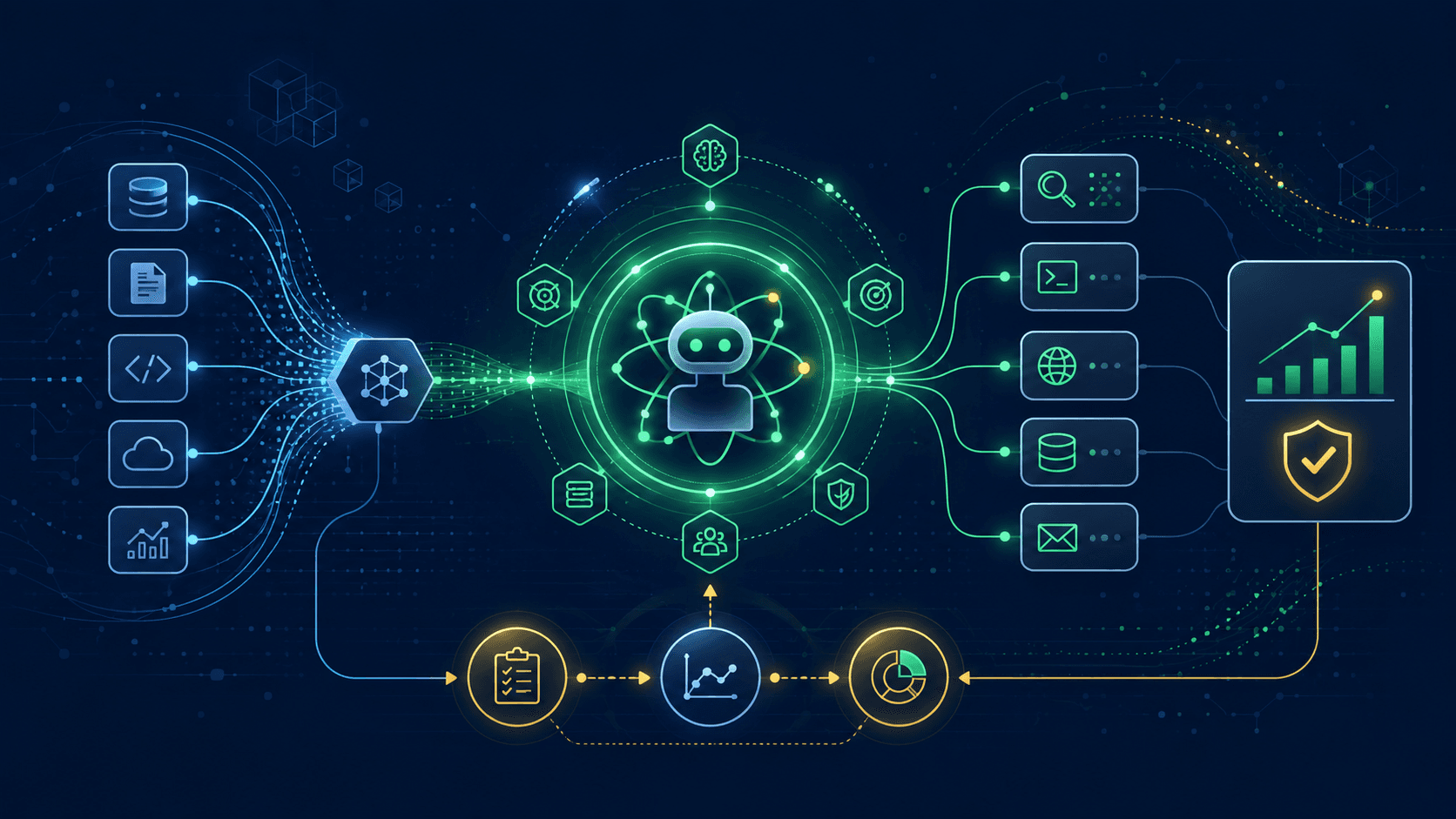
Every team can build an AI agent that dazzles in a demo. Far fewer can build one that holds up on a Tuesday afternoon when a real customer is waiting, the data is messy, and the stakes are someone's money. The gap between those two states is where most enterprise AI initiatives quietly stall.
Over the last few years, "agentic" has shifted from a research curiosity to a board-level expectation. The promise is genuine: software that can reason over your tools and data to complete multi-step work. But the path from promise to production is paved with operational concerns that demos are specifically designed to hide.
The demo trap
A demo optimizes for the happy path. It uses curated inputs, a forgiving audience, and a narrow task. Production does the opposite -- it throws ambiguous requests, partial data, and edge cases at your system continuously, and it expects a sensible response every time.
The question is never "can the agent do this once?" It's "can the agent do this ten thousand times, safely, and can we prove it?"
When teams skip that second question, they ship something that erodes trust the first time it confidently does the wrong thing. And trust, once lost, is expensive to rebuild.
What production actually requires
Moving an agent into dependable operation means treating it like any other critical system. In practice, that comes down to five disciplines:
- Observability -- every decision, tool call, and input logged and traceable, so you can answer "why did it do that?" after the fact.
- Guardrails and approvals -- hard limits on what the agent can do autonomously, with human sign-off on irreversible or high-risk actions.
- Evaluation -- a golden dataset and automated scoring, so you catch regressions before your users do.
- Grounding -- answers anchored to your real, current data rather than the model's training-time guesses.
- Security -- least-privilege access, encryption, and clear boundaries around sensitive data.
A reference architecture
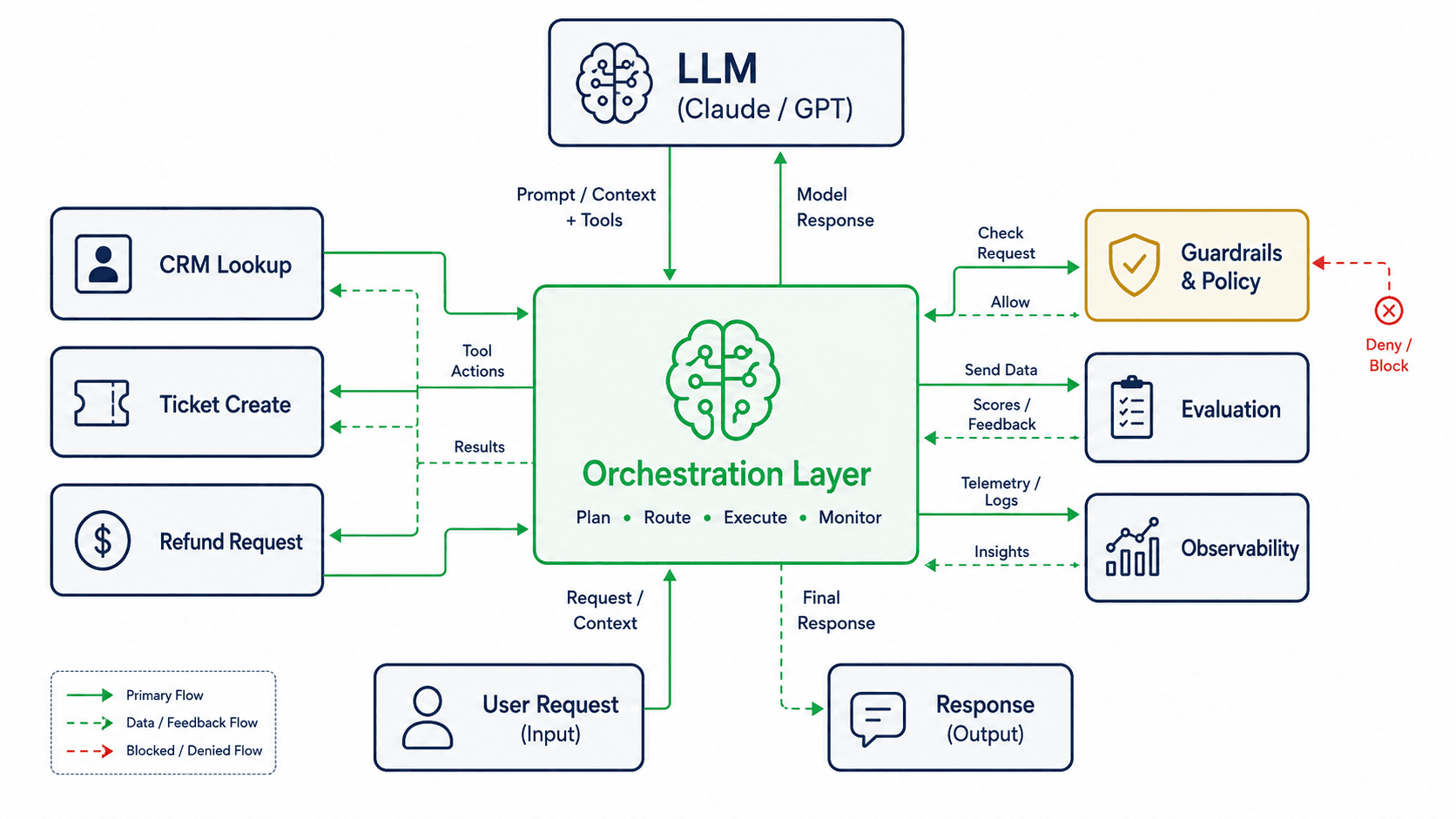
None of this requires exotic infrastructure. A dependable agent is mostly a well-instrumented orchestration layer around a model, with explicit policy on what it may and may not do:
// agent.config.ts
export const agent = {
  model: "claude",
  tools: [crmLookup, ticketCreate, refundRequest],
  guardrails: {
    requireApproval: ["refundRequest"],
    denyOutsideHours: true,
  },
  eval: { dataset: "golden-set", threshold: 0.9 },
  observability: { trace: "all", redactPII: true },
};
The configuration is the contract. It states, in one place, what the agent is allowed to touch, what needs a human in the loop, and the bar it has to clear before a change ships. Reviewers can read it; auditors can trust it.
Building the evaluation pipeline
The most overlooked discipline is evaluation. Without it, every model upgrade and prompt tweak is a gamble. A practical evaluation pipeline has three layers:
- Unit-level assertions -- deterministic checks on individual tool calls and structured outputs. Does the agent call the right tool with the right parameters for a known input?
- Scenario-level scoring -- run the agent against a curated set of realistic tasks and score the final outcomes. Track accuracy, latency, and cost per task.
- Drift detection -- continuously compare production behavior against your golden set. When the distribution shifts, you know before your users complain.
Automating this into your CI/CD pipeline means every change is evaluated before it reaches production -- the same discipline we apply to traditional software, extended to probabilistic systems.
Organizational readiness
Technology is rarely the bottleneck. The harder work is organizational: establishing clear ownership of agent behavior, defining escalation paths when the agent is uncertain, and building the feedback loops that let the system improve over time.
The teams that succeed tend to start with a cross-functional squad -- an engineer, a domain expert, and someone who owns the process the agent is augmenting. They define success criteria together, review agent outputs together, and iterate in short cycles.
Where to start
The most successful programs do not begin with the most ambitious use case. They begin with a narrow, well-bounded task that has clear success criteria and a tolerant failure mode -- then they harden it until it is genuinely reliable. That first dependable agent becomes the template, and the operational muscle you build carries into everything that follows.
Intelligent automation pays off when it is boring in the best sense: predictable, observable, and accountable. That is not the part that demos well -- but it is the part that lasts.

Founder & Principal Consultant at VerionSys. 24+ years delivering enterprise systems across AI, cloud, and integration in Brazil, Canada, and the USA.
Connect on LinkedIn